
There is no single product that makes a work zone safe. The crews that go home every night are protected by layers: devices that keep drivers out, devices that slow them down, devices that absorb a hit, and, increasingly, devices that see the hit coming and warn everyone before it lands.
This guide walks through the work zone safety solutions available to state DOTs, counties, and contractors in 2026, what each one does well, where each one falls short, and how to combine them. If you are writing a spec, building a safety plan, or just trying to understand what the options are, start here.
Work zone crashes are not improving at the pace of the rest of the road. NHTSA's early estimate shows overall traffic deaths fell to a record-low rate in 2025. Yet in the 2026 AGC and HCSS Highway Work Zone Safety Survey, 60 percent of highway contractors reported at least one crash in their work zones in the past year, nearly a third reported five or more, and more than half said the risk is higher than it was a year ago.
The causes are familiar. Distracted driving. Speed. Nighttime work, where FHWA reports roughly half of fatal work zone crashes now occur. And a set of traditional tools that were designed to survive a crash rather than prevent one.
The solutions below are grouped by what they do. Most agencies will need something from every group.
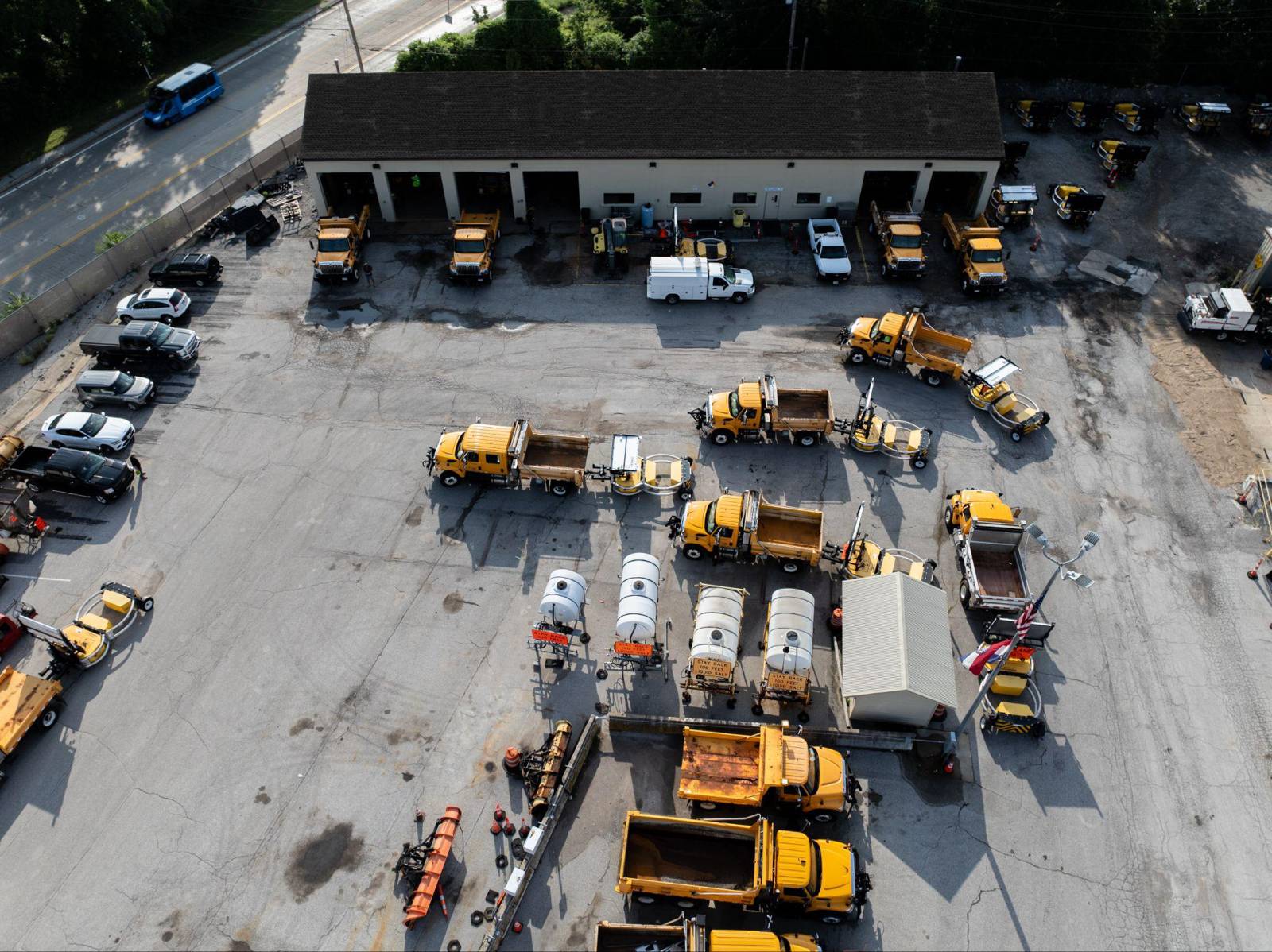
Positive protection means a physical device between traffic and workers. Portable concrete barrier, moveable barrier systems, and truck-mounted attenuators (TMAs) all belong here. A TMA is a crash cushion on the back of a shadow truck that absorbs the energy of a vehicle strike so the crew ahead of it does not.
Federal rule 23 CFR 630.1108 requires agencies to use positive protection, at a minimum, in work zones with high operating speeds that give workers no means of escape, unless an engineering study says otherwise. It also lists the situations that trigger a positive-protection evaluation, including high-speed roads, long-duration projects, and night work near drop-offs.
Where it falls short: positive protection is passive. A TMA is built to take the hit. It cannot tell the crew the hit is coming. That gap is what the newer solutions in this guide are designed to close.
Signs, channelizing devices, arrow boards, and portable changeable message signs (PCMS) are the backbone of every work zone, and the Manual on Uniform Traffic Control Devices governs how they are used. The 11th edition became the required standard for every state in January 2026, so if your typical applications have not been reviewed against it, that is the first thing to check.
Flaggers and automated flagger assistance devices (AFADs) belong in this group too. AFADs take the flagger out of the lane, which removes one of the most exposed positions on any job.
Where it falls short: traffic control depends entirely on driver attention. Drivers who are distracted, impaired, or fatigued tune out cones and signs. FHWA's Work Zone Management Program is explicit that devices alone do not stop intrusions.
Speed is a factor in more than 30 percent of fatal work zone crashes. Three tools are in wide use:
Where it falls short: enforcement deters, but it does not detect. A camera that mails a ticket next week does nothing for the crew in the lane right now.
An intrusion alarm detects a vehicle entering, or about to enter, the protected work space and warns workers instantly. FHWA's Every Day Counts nighttime work zone initiative is actively helping states deploy them, and the federal rule names them among the measures agencies should consider.
The older generation was mechanical: a vehicle hit a pneumatic tube or knocked over a sensor cone and a horn sounded. The current generation uses radar, AI video, or both to track approaching vehicles and predict an intrusion before it happens, then fires horns, strobes, and wearable alerts in a fraction of a second. We cover the technology, the rules, and what to look for in our full guide to work zone intrusion alarm systems.
Where it falls short: alert timing has to be tuned. Too early and crews ignore it. Too late and there is no time to move. Ask any vendor how their thresholds were set and whether they scale with posted speed.
A smart work zone uses sensors and connected signs to manage traffic approaching and inside the zone in real time. The most common application is end-of-queue warning: sensors upstream detect slowing traffic and message signs tell drivers to expect stopped vehicles ahead. Rear-end crashes at the back of a queue are among the deadliest work zone crash types, and USDOT's ITS evaluation research documents meaningful reductions where these systems are deployed.
Other smart work zone functions include dynamic lane merge, travel-time messaging, and automatic incident detection for stalled vehicles or wrong-way drivers. Omnisight's automatic incident detection and queue alerting run on the same radar-and-video sensor used for intersections and highways.
Where it falls short: smart work zones manage the traffic stream. They protect drivers more than they protect the crew. Pair them with intrusion detection to cover both.
Vehicle-to-everything (V2X) communication pushes a warning into the approaching vehicle itself: a work zone ahead, a lane closure, a stopped queue. FHWA's national V2X deployment plan singles out work zones as a priority use case, and 2024 federal grants funded deployments in Arizona, Texas, and Utah that include work zone applications.
V2X needs a detection layer to know what to broadcast. That is where roadside and vehicle-mounted sensors come in. Read our explainer on how V2X technology works or see how FusionSensor feeds V2X alerts.
Where it falls short: coverage. Only a fraction of the vehicle fleet can receive V2X messages today. It is a strong future layer, not a replacement for on-site warning.
Horns and strobes do not reach a worker running a saw with hearing protection on, facing away from traffic. Wearable alerts close that gap: vests and helmets that vibrate when an intrusion system or proximity sensor fires. Some state DOTs now accept worker-worn proximity sensors as a supplement to zone-based intrusion alarms.
Where it falls short: a wearable is only as good as the detection that triggers it. On its own, a proximity sensor warns late. Connected to a radar-based intrusion system, it warns in time.
The least visible solution may be the most valuable over time. Systems that record every intrusion, speeding event, and near miss give safety managers evidence. Which closures produce the most close calls? Which times of day? Which setups have a buffer that is too short? That data feeds the next traffic control plan, supports enforcement requests, and documents what happened when a strike does occur.
The Work Zone Safety Information Clearinghouse maintains crash data, research, and training resources that are useful when building the case for a new countermeasure internally.
No agency buys everything at once. A practical way to layer the options:
Omnisight's FusionBLADE covers layers four, seven, and eight in one device. It mounts on the back of the attenuator truck, fuses HD3D radar with AI HD video to track every approaching vehicle from well beyond the taper, and fires dual air horns, LED warning lights, wearable haptic alerts, and dashboard notifications in under 100 milliseconds when a driver is on a collision path. The alert goes out before the vehicle enters the work zone, not after. Every event is recorded on the device for review.
It was developed with the Missouri Department of Transportation over a year of field pilots. How far out the alert fires is adjustable and is the agency's decision. Our recommendation from that work is 1.5 to 2 seconds before predicted impact: enough time for the driver to react and avoid the incident, and not so far out that the system alerts too often and crews tune it out. MoDOT has since sole-sourced the system for its statewide TMA fleet, and Valtir now supplies FusionBLADE for truck- and trailer-mounted attenuators across North America. You can read how FusionBLADE came to be, or see the full work zone safety overview.
Work zone safety solutions work best in layers. Positive protection and traffic control are the floor. Speed management, intrusion alarms, smart work zone systems, V2X, and wearables each close a different gap. The agencies seeing results are the ones that stopped treating the crash as the warning and started specifying tools that respond before impact.
If you are building a safety plan for the coming season, talk to our team about where active detection fits.
Subscribe to The Edge Brief for monthly field notes, deployment stories, and product updates.
Subscribe →