
Most highway crashes happen at an angle, a glancing blow, a rear-end at a queue. A wrong-way crash is different. Two vehicles meet head-on at a combined closing speed well over 100 mph, usually at night, usually with no time to react. That is why a crash type that accounts for a small share of collisions accounts for an outsized share of deaths.
This guide explains what a wrong-way driver detection system is, where wrong-way drivers come from, how states are deploying detection at scale in 2026, and what to look for in a system that will actually hold up on a ramp.
Federal crash data puts U.S. wrong-way deaths in the range of 300 to 500 a year, and NHTSA studies have found a wrong-way crash is roughly nine times more likely to be fatal than other highway crashes. The trend is not improving. A 2025 Washington State DOT review of national data counted 445 fatal wrong-way crashes nationwide in 2018 and 704 in 2022.
The AAA Foundation's analysis of who ends up driving the wrong way is consistent: the odds climb with alcohol impairment, with age over 70, and with driving alone. Most of these drivers are not trying to do anything dangerous. They made a turn onto an exit ramp they mistook for an entrance, often late at night, and the geometry of the interchange did the rest.
Almost every wrong-way highway crash begins at an exit ramp. Certain designs produce far more than their share:
The first line of defense is passive: larger signs, signs mounted lower to meet a driver's sightline, red reflective pavement markers, and arrows on the pavement. Those help a sober, alert driver. They do nothing for the driver who has already passed them.
A wrong-way vehicle detection system, or WWVDS, adds an active layer at the ramp. It has three jobs, and it has to do them in seconds:
The whole sequence has to happen before the driver clears the ramp. On a short ramp at 30 mph that is well under ten seconds, which is why detection latency is the first spec that matters.
Detection has moved from pilots to programs. Connecticut DOT activated its 300th system in September 2026, with funding for 400, and reports that more than 1,000 drivers have triggered a system and turned around since the program began. The state had 13 wrong-way crashes with 23 deaths in 2022, the year before the rollout.
Ohio DOT has reported that 83 percent of drivers who triggered its central Ohio systems in 2024 turned around before reaching the highway. Florida's program is the longest running and the model most states borrowed from. Pennsylvania, Massachusetts, Arkansas, and Texas all have deployments or tests underway.
Those turnaround rates are the number to watch. A system that gets eight or nine of every ten wrong-way drivers to stop on the ramp is preventing head-on crashes directly, not just documenting them.
Every WWVDS can detect a car driving up a ramp on a clear afternoon. The differences show up in the cases that matter:
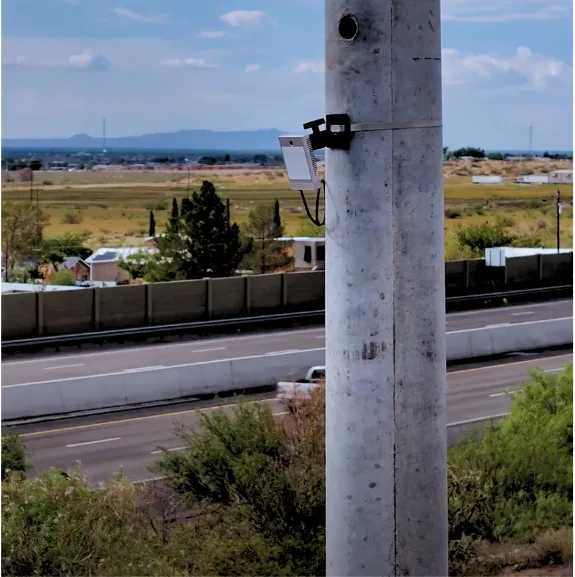
Omnisight's wrong-way detection runs on FusionSensor, which pairs HD3D Doppler radar with AI video on one device. The radar reads direction of travel through fog, rain, snow, and darkness. The video classifies the object. Both sensors have to agree that it is a vehicle and that it is moving the wrong way before an alert fires. On a turnpike exit ramp where it replaced separate camera and radar detectors that had been flagging mowers and shadows, every alert since has been a real wrong-way vehicle.
Detection to sign trigger is under 500 milliseconds. The sensor drives the ramp's existing signs and the TMC's DMS boards over contact closure, NTCIP, or SDLC, runs on PoE, and mounts on a pole in under an hour. After installation, Omnisight engineers review the early alerts with the agency's operations team and tune the fusion thresholds to the site.
Wrong-way crashes are rare, deadly, and almost entirely preventable at the ramp. The states deploying detection at scale are measuring success in turnarounds, and the systems earning that trust are the ones that fire fast, work at night, and never cry wolf. If you are scoping a ramp program, start with our eight questions for specifying a wrong-way detection system, or talk to our team about the ramps that keep you up at night.
Subscribe to The Edge Brief for monthly field notes, deployment stories, and product updates.
Subscribe →